Showing posts with label metagaming. Show all posts

Saturday, November 12, 2011

Possible Moves for Operational Commanders

What medieval armies can do best.
March (field army)
  • Progress ~10 miles in a day.
  • Pillage a burn all non-fortified settlement.
  • Scout 1 day ahead in all possible directions.
  • Unlikely  to cause fatigue.
  • Uses victual stores.
  • Prevents desertion and infiltration.
  • Options/Emphasis:
    • Speed first :
      • Likelier to get tired, Select the shortest anticipated route, less likely to be found by scouts, bypass castles, walled towns.
    • Profit first :
      • Select the most profitable route, Automatically attempt to impress fortified obstacles (if not, bypass), Good for morale (in general).
    • Tactical : 
      • Tight column movement, less likely to be ambushed, slow, likelier to get tired.
  • End triggers:
    • Specified destination reached.
    • Specified time span reached (1 day by default).
    • Opportunity OR challenge encountered.


Rest (field army)
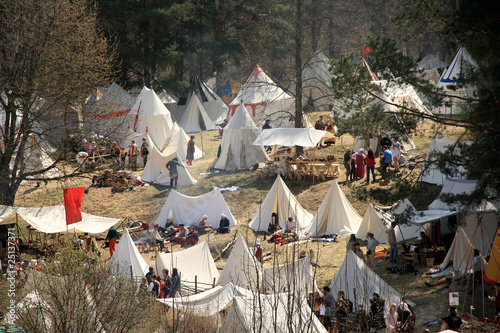
Resting with your 10,000 best friends
and no running water.

  • No progress toward objective.
  • Higher rate of victuals consumption.
  • Resting.
  • Likelier to be found by scouts.
  • Options/Emphasis:
    • Reorganization
      • Address discipline, cohesion, training.
  • End trigger:
    • Specified time (default= until rested).
    • Specified length
    • Opportunity OR challenge encountered.


Sieges, the worst way to spend
time in the field.
Besiege (field army)


  • No movement, scouts used as defensive screen.
  • Higher victuals consumption.
  • Lower fodder consumption.
  • Daily attempt to negociate surrender.
  • Engineering operations : make siege engines, sapping, etc.
  • No looting of wealth.
  • Morale depend on belief in a successful outcome.


Sign your name here and I'll give you a shiny helmet.
Indenture (Friendly territory only)

  • 1/8 of total population is likely be raised as troops in 1 Month (or 1/16 in two weeks, or 1/32 in one week, etc.). Every increase in proportion, or cut in time by a factor 2 makes it less likely
  • Troop type and quality depends on:
    • Local specialty.
    • Warfaring tradition.
    • Loyalty.
    • Funds.
    • Non-immediate threat to home base.
  • Can be applied on foreign specialists (Genoese crossbowmen, Swiss Pikemen, German Mercenaries, etc). Ask GM for parameters.


Alright, the metal bit at the end goes
into Englishmen's vital organs.
Activate Militia (Owned territory only)
  • Like Indenture, but up to 1/4 population in 2 weeks.
  • Troops quality almost always untrained for maneuvers.
  • Bound to defense of their own community (use Indenture otherwise).
  • Do not depend on funds, but depend on weapon and armor stores.
  • Likely to affect the local economy. 
  • Less likely to be successful in non-fortified area.
  • Likelier in localities with Castles and Fortresses.


Evacuate Civilians (Owned territory only)

  • Deny opponent some/all of the loot.
  • Faster economic recovery (but enhanced chance of famine later).
  • Liege Lord responsible for victuals and accommodation. 

Thursday, November 10, 2011

Phase 2

Phase two is going to use two private website to keep track of two factions. Only when Phase 2 will be done, the posts from the privates sites will be imported to the main site for reading.

If anyone want to be added to the reader's list for either site, please contact me.

Saturday, November 5, 2011

The Fog of War - World

Design Constraints
This post outlines the procedure by which the world will be defined as the game progresses. In a realistic medieval setting, a traveler would not have access to a map to find his/her bearing. Instead, the world is represented by a mental representation of a number of landmarks and how they relate to each other. The notion of dimensions and scale is approximative and subject to the personal experience of individuals. In this game, it will not be possible for a player to know France better than the actor do by simply consulting Google Earth.

World abstraction
The world in the Chevauchee is abstracted as a collection of landmarks. A landmark is either a natural feature, a major town or river. For practical reasons, the entire area covered by one day's march is considered together. Each landmark is abstracted as one area, and connected by an abstract path which may have any number of attributes. The minimal description must contain the following:

  1. Intervening terrain : what kind of terrain exists between two landmarks.
  2. Distance estimate : Either an estimate of the number of days of march, or the label "near", "far" or "very far". The three labels respectively means that the likelihood to get any closer on the following days is "somewhat likely" (10), "unlikely" (8) and "very unlikely" (6). Getting closer to "near" means that the next day's march lead directly to the destination.
From the starting point, the GM first determine whether the next day's walk gets the march any closer to destination. If the next day's march is NOT the destination, a new area is created and populated with random data:
  1. Distance to destination.
  2. Is there a path going forward? 
  3. Is it possible to go left, right?
  4. What is the terrain in this area (population, settlement, wealth, food and fodder, etc). 

The use of scouts allow to determine the properties to all adjacent areas prior to selecting the destination of the next day's march. A move to the left or right will not alter the distance estimate: only a move forward can do this.

As a consequence, it is not possible to know what is the shortest path between point A and B ahead of the march because the path doesn't exist yet (but is almost guaranteed to occur at some point). Opponents may even seek each other without even knowing that they are close to each other (although this is a more complicated story).

Terrain definition


Countryside (rural areas, small unwalled villages and farmlands)

  1. Odds of a left/right path : Somewhat likely
  2. Odds of a path going forward : likely
  3. Population size category (3D6 + 1)
  4. Fortifications (size above 12) : likely
  5. Intervening river: unlikely
Mountain (Broken terrain, low population)

  1. Odds of a left/right path : unlikely
  2. Odds of a path going forward : likely
  3. Population size category (3D6 - 1)
  4. Fortifications (size above 10) : likely
  5. Intervening river: very unlikely
Forest (Broken terrain, low population)

  1. Odds of a left/right path : unlikely
  2. Odds of a path going forward : somewhat likely
  3. Population size category (3D6)
  4. Fortifications (size above 10) : likely
  5. Intervening river : unlikely
A river forces is unlikely to be forded in one area, but all area with a "fortification" has a bridge, which requires access to the fortification to be crossed. When there is an intervening river, only left and right areas are accessible.

to be continued.

How does a turn works during the Mobilization phase?

This post describes how a turn is handled during the mobilization phase.

A post is prepared
This post describes what happen since the last update and what are the outcomes of the instructions provided by the player in the comments of the last post. It also provides a bullet point form summary of the outlook for mobilization for a number of relevant items.

The player controlling this actor is invited to submit instructions.

Processing instructions
Each instruction is considered in the provided order. The first instruction is converted into a TOEM initiative (summary here). An initiative is made of an action or event and an effect. A base probability is assigned, supporting arguments are added as well as counter arguments. These are tallied to come up with a target number between 3 and 18. 3D6 are rolled and the effect is achieved if the sum of the dice is equal or less than the target. There is a bit more to this, but this is mainly how it is done. If the initiative is successful, the GM moves to the next one until there are no initiative or one of them is unsuccessful. Command points are tallied for these initiative and added to the player's score.

Once the player's initiatives are processed, each mobilization outlook item is treated as an automatic initiative. These are modulated by player actions and the outcome of items in the previous turn. The actual setup for the campaign will be determine based on the final state of these outlook items when the fleet is sailing.

Strategies for players
Assume that, if you do nothing, your actor would follow the standard practice of its contemporary. If you don't order anything, actions will be taken that are as much as possible in line with historical decisions. However, this may not be enough to succeed... hopefully not. If your actions are in contradiction with the practices at the time, the GM will let you know and ask for a confirmation. The 14th century is a strange time of our history: some things are rather progressive (no compulsory military service) and some are just strange with respect to our way of thinking (little value to human life and dignity for civilians, no maps, etc.).

  1. Prioritize: all initiative following an unsuccessful initiative are not resolved. This is because the actor just got sucked in a losing activity for the rest of the turn and "lost the initiative". You may want to put trivial orders ahead of less likely events to ensure that they take place.
  2. Point out why something would (or not) work: any arguments put forward to justify what an effect should occur may be used by the GM in determining the target number of an initiative. Likewise, pointing out flaws or unfavourable arguments may be weighted less than if they are not identified by the player. 
  3. Ask for assessments: Before finalizing your orders, you can ask the GM to outline your instructions as TOEM initiative and assess their likelihood. This gives you a chance to reorder the instructions, argue in favour of one or more initiative. Make sure that you OK the instructions eventually so the GM can move forward.


Thursday, November 3, 2011